Document Summarization#
Overview#
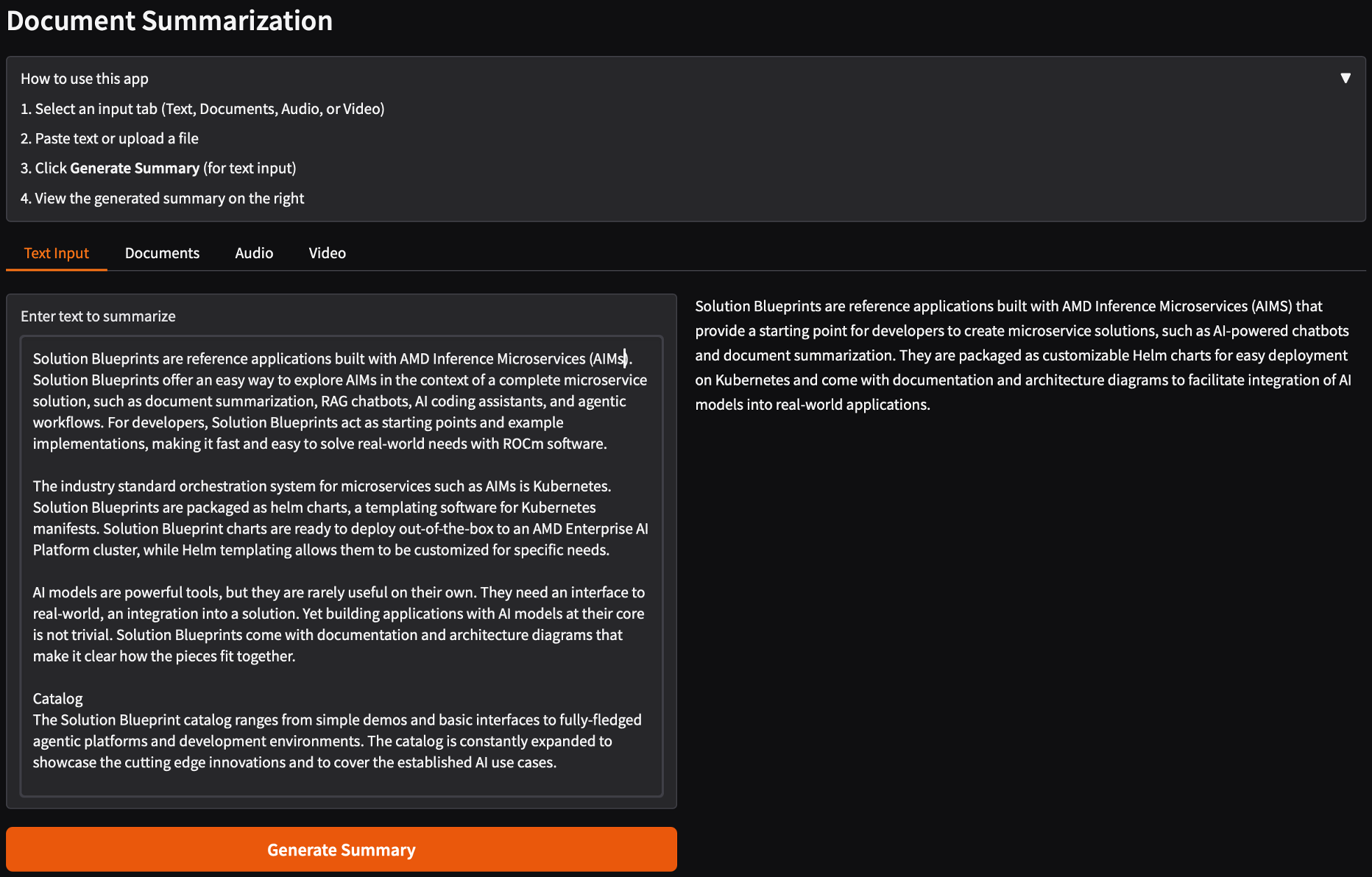
The Document Summarization (DocSum) Solution Blueprint uses LLMs to generate summaries from varied document types. It can process and summarize PDFs, DOCX files and plain text, as well as multimedia files (both audio and video), across a variety of domains such as customer service, scientific research and legal text.
AMD Solution Blueprints are packaged as Helm charts for deployment on a Kubernetes cluster. For development or further exploration, the source code is public and available in the Solution Blueprints GitHub repository.
Architecture#
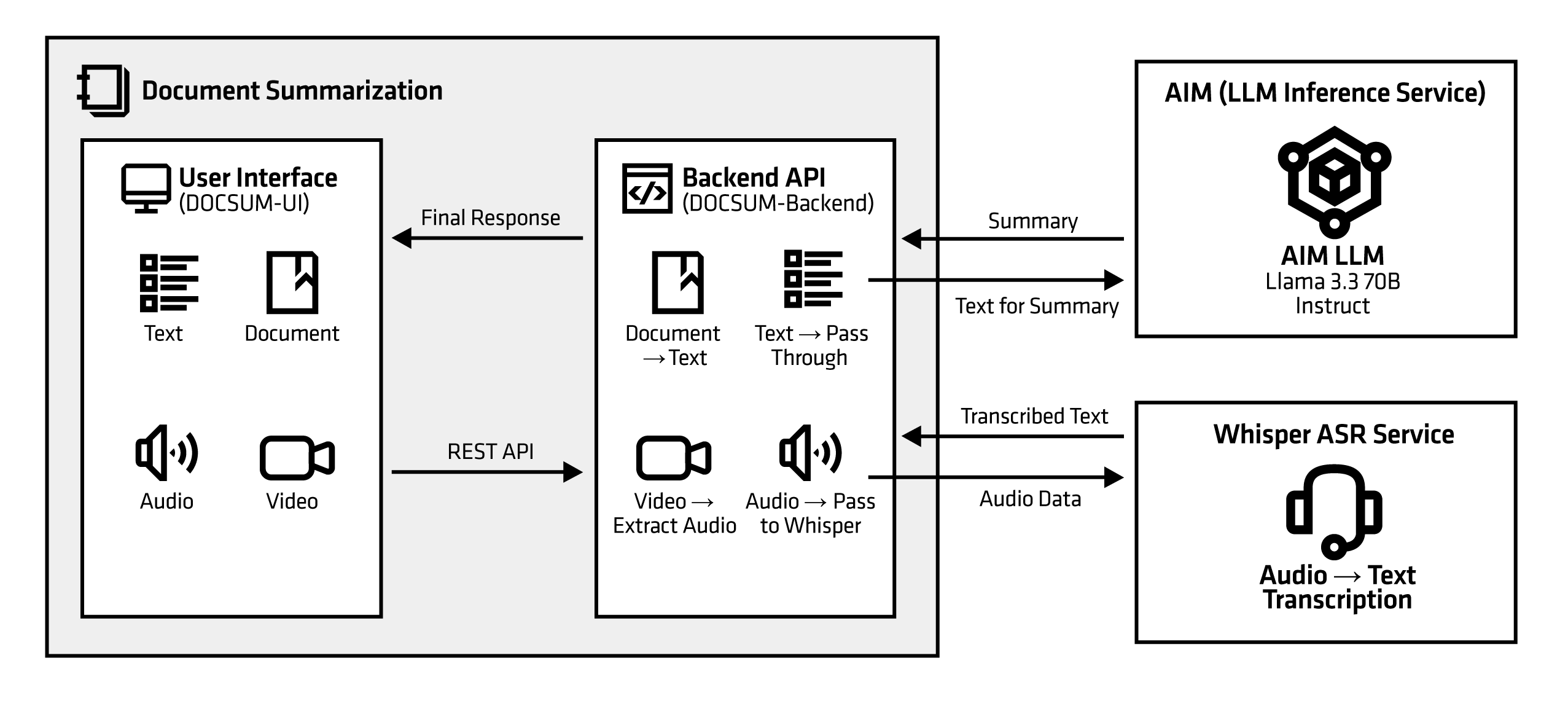
Component |
Role |
|---|---|
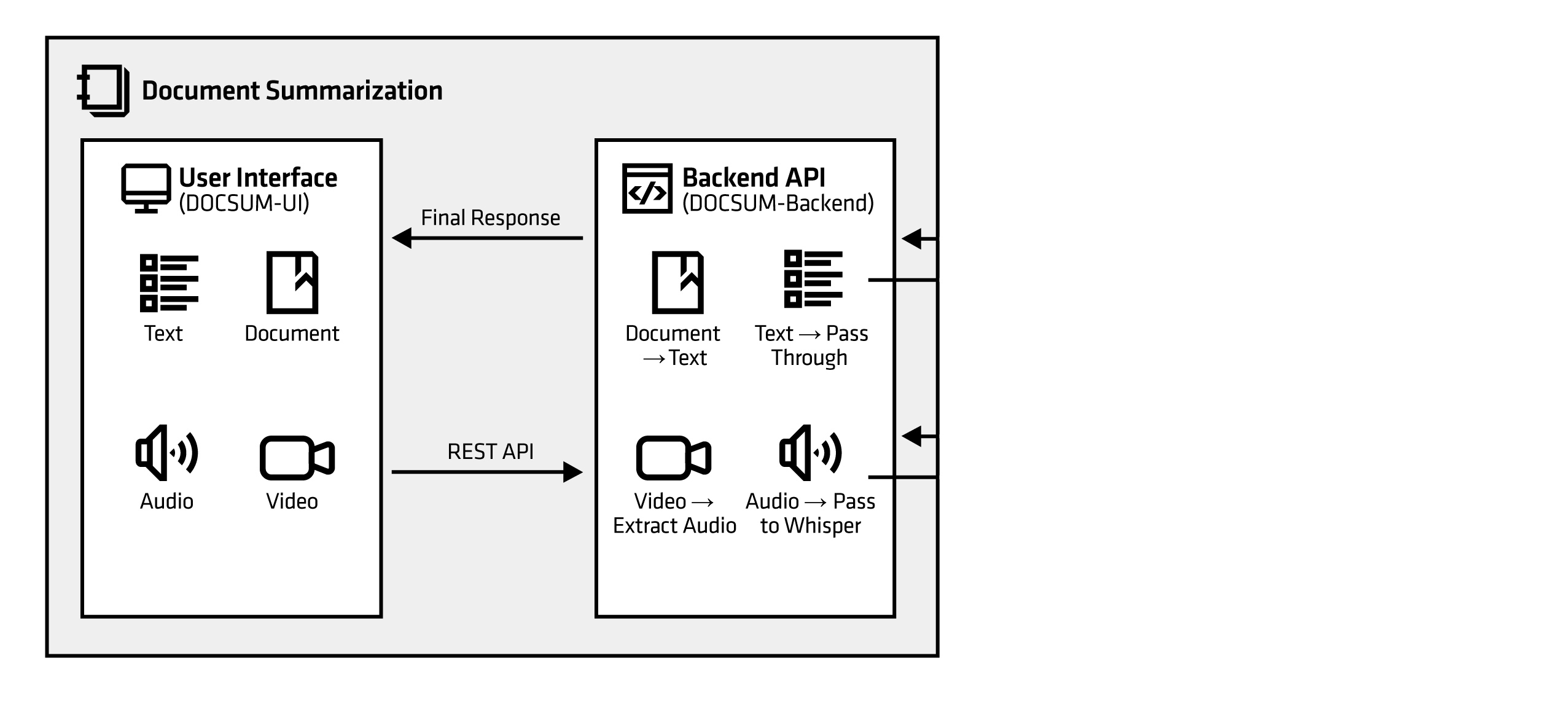
User Interface |
Web interface for uploads, URLs, and viewing summaries |
Backend API |
DOCSUM backend integration between components |
Whisper |
Automatic transcription for audio and video inputs |
AIM LLM |
Summarization and language understanding (default: Llama 3.3 70B Instruct) |
Key Features#
Multi-format support: PDF, DOCX, text, audio, and video
Automatic transcription: Whisper-based speech-to-text for multimedia files
LLM-powered summarization: Deploy with AIM
Microservices Architecture: Modular design with independent, scalable components
Getting Started#
This is a quick start guide on how to deploy the blueprint. For advanced options, such as reusing an existing AIM, providing a Hugging Face token, or overriding storage classes, see Deploying Solution Blueprints with Helm or explore the advanced deployment guide.
Prerequisites#
System Requirements#
This blueprint can be deployed on AMD Instinct (default), AMD EPYC, and AMD Radeon. The blueprint requires the following cluster resources by default, depending on the hardware being used:
Resource |
Instinct |
Radeon |
EPYC |
|---|---|---|---|
GPUs |
1 |
1 |
— |
CPUs |
5 CPU cores |
5 CPU cores |
189 CPU cores |
RAM |
65 Gi |
33 Gi |
129 Gi |
To deploy to the Kubernetes cluster, ensure the following prerequisites are met:
Deployment#
For advanced deployment options, explore the advanced deployment guide. Solution Blueprints are packaged as OCI-compliant Helm charts in the Docker Hub registry and can be deployed to a Kubernetes cluster with a single command. Define the name (deployment name) and the namespace (Kubernetes namespace), then pipe the output of helm template to kubectl apply -f -.
Find the deployment command below.
Note: You can create a namespace using kubectl create namespace <my-namespace>.
name="my-deployment"
namespace="my-namespace"
helm template $name oci://registry-1.docker.io/amdenterpriseai/aimsb-docsum \
  | kubectl apply -f - -n $namespace
EPYC runs the model on CPU (gpus=0, bf16, AIM_ALLOW_UNOPTIMIZED=true), sized via llm.cpus/llm.memory. The default EPYC AIM is a gated image, so provide a Hugging Face token through a Secret.
name="my-deployment"
namespace="my-namespace"
kubectl create namespace $namespace
kubectl create secret generic hf-token --from-literal=hf-token=<YOUR_HF_TOKEN> -n $namespace

helm pull oci://registry-1.docker.io/amdenterpriseai/aimsb-docsum --untar
helm template $name ./aimsb-docsum \
  --set global.platform=epyc \
  --set llm.cpus=188 \
  --set llm.memory=128 \
  --set llm.env_vars.HF_TOKEN.name=hf-token \
  --set llm.env_vars.HF_TOKEN.key=hf-token \
  | kubectl apply -f - -n $namespace
Performance note: On multi-socket EPYC nodes, configure the kubelet for NUMA alignment (CPU Manager
static, Topology Managersingle-numa-node, Memory ManagerStatic); otherwise the LLM’s CPUs and memory can land on different NUMA nodes and vLLM runs effectively single-threaded.
name="my-deployment"
namespace="my-namespace"
helm template $name oci://registry-1.docker.io/amdenterpriseai/aimsb-docsum \
  --set global.platform=radeon \
  | kubectl apply -f - -n $namespace
Verify Deployment#
To check the status of the deployment, run:
kubectl get pods -n $namespace
Wait until all pods report Running and Ready. Summarization requires the LLM (and Whisper for media paths) to be up; the default AIM may take several minutes to start.
Connect to UI#
To connect to the UI, port-forward to 5173. The UI is then available at http://localhost:5173 in your browser.
kubectl port-forward services/aimsb-docsum-${name}-ui 5173:5173 -n $namespace
Once connected, use the application as follows:
Choose a source: Upload one or more supported files (Text, Documents, Audio, or Video)
Click “Generate Summary” to submit the request and wait for the summarization to finish
Review the generated summary in the UI
Clean Up#
When you are finished, remove the deployed resources using the same deployment command, with kubectl delete instead of kubectl apply. For example, for Instinct use the following command:
helm template $name oci://registry-1.docker.io/amdenterpriseai/aimsb-docsum \
  | kubectl delete -f - -n $namespace
Third-Party Components#
This Solution Blueprint uses multiple third-party components. To see the full set of software and Python dependencies, explore the repository source and dependency files. For further license information, refer to each component’s official documentation.
Terms of Use#
AMD Solution Blueprints are released under the MIT License, which governs the parts of the software and materials created by AMD. Third-party Software and Materials used within the Solution Blueprints are governed by their respective licenses.