LLM-Chat#
Overview#
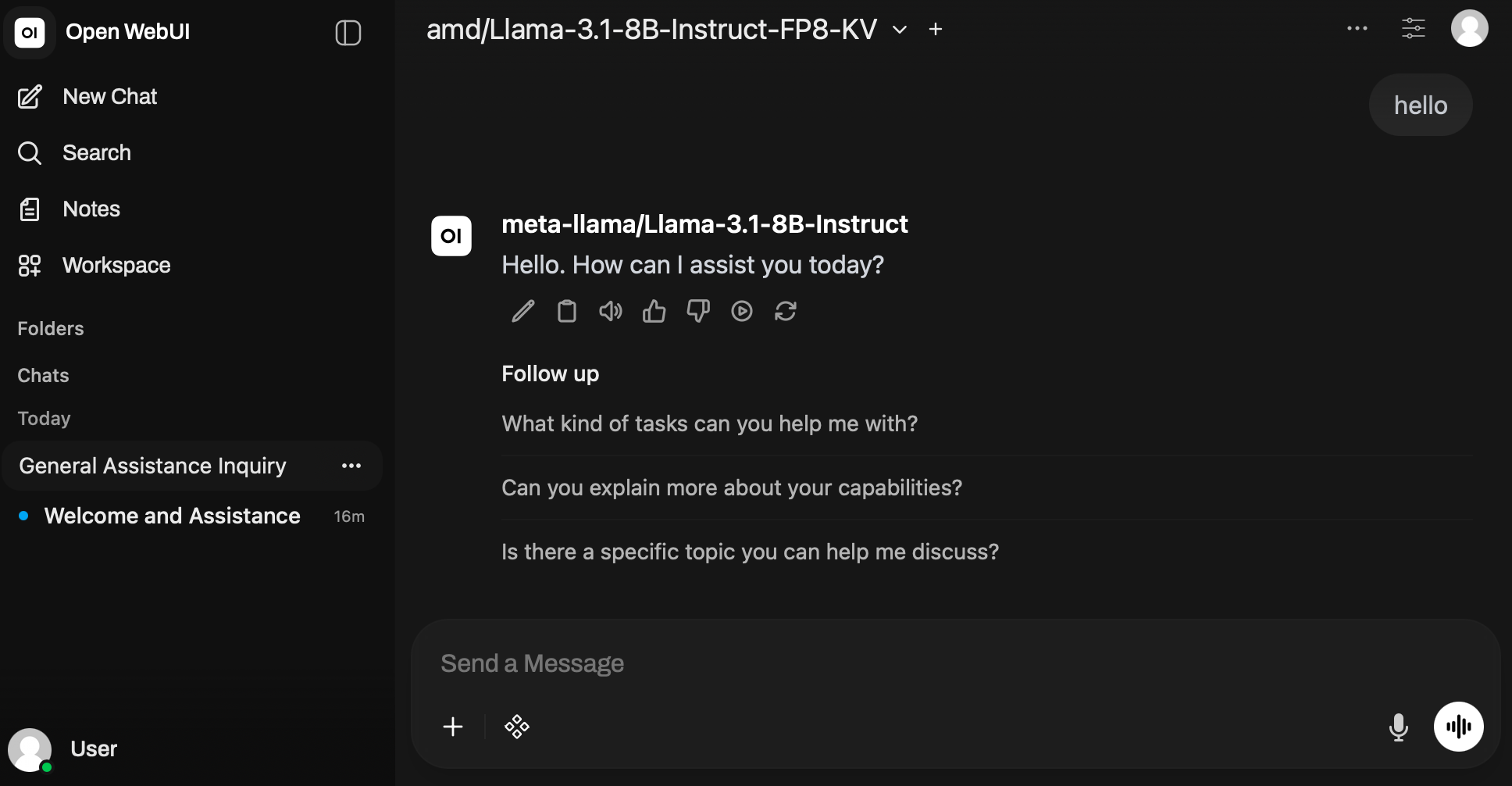
Chatting with an LLM is often a good way to perform an initial evaluation. This is a sanity check that lets us quickly get a feel for what the LLM is capable of and what style of responses it tends to generate. Even before standardized test suites, we can explore prompting techniques and understand model behavior.
This Solution Blueprint combines two parts:
The open-source OpenWebUI chat application. Open WebUI is a third‑party open-source project; trademarks belong to their respective owners.
The user’s chosen AIM deployed alongside it.
AMD Solution Blueprints are packaged as Helm charts for deployment on a Kubernetes cluster. For development or further exploration, the source code is public and available in the Solution Blueprints GitHub repository.
Architecture#

The blueprint integrates OpenWebUI with an AIM LLM service.
Component |
Role |
|---|---|
OpenWebUI |
Web chat interface and configuration |
AIM LLM |
Inference for chat completions (default: Llama 3.1 8B) |
Key Features#
A feature-rich, user-friendly LLM chat platform provided by the open-source OpenWebUI
Flexible AIM deployment:
AIM LLMs provide a robust, scalable inference runtime that is optimized for AMD hardware.
Talk with the AIM in a back-and-forth classic chat interface and get access to a wide array of inference parameters like the system prompt, temperature and various other constraints.
Getting Started#
This is a quick start guide on how to deploy the blueprint. For advanced options, such as reusing an existing AIM, providing a Hugging Face token, or overriding storage classes, see Deploying Solution Blueprints with Helm or explore the advanced deployment guide.
This blueprint supports AMD Instinct (default), AMD EPYC, and AMD Radeon platforms. The section below covers the default Instinct deployment. For EPYC and Radeon deployment and other advanced options, see:
Prerequisites#
System Requirements#
The blueprint requires the following cluster resources by default:
Resource |
Default Configuration |
|---|---|
GPUs |
1 |
CPUs |
5 CPU cores |
RAM |
68 Gi |
To deploy to the Kubernetes cluster, ensure the following prerequisites are met:
Deployment#
Solution Blueprints are packaged as OCI-compliant Helm charts in the Docker Hub registry and can be deployed to a Kubernetes cluster with a single command. Define the name (deployment name) and the namespace (Kubernetes namespace), then pipe the output of helm template to kubectl apply -f -:
name="my-deployment"
namespace="my-namespace"
helm template $name oci://registry-1.docker.io/amdenterpriseai/aimsb-llm-chat \
  | kubectl apply -f - -n $namespace
Note: You can create a namespace using kubectl create namespace $namespace.
To check the status of the deployment, run:
kubectl get pods -n $namespace
Wait until all pods report Running and Ready.
Connect to UI#
To connect to the UI, port-forward to 8080. The UI will then be available at http://localhost:8080 in your browser.
kubectl port-forward services/aimsb-llm-chat-${name} 8080:80 -n $namespace
Once connected, use the application as follows:
Open the chat interface in your browser
Adjust inference settings as needed (for example, system prompt and temperature)
Send messages and review the model’s responses
Clean Up#
When you are finished, remove the deployed resources:
helm template $name oci://registry-1.docker.io/amdenterpriseai/aimsb-llm-chat \
  | kubectl delete -f - -n $namespace
Third-Party Components#
To see the full set of software and Python dependencies, explore the repository source and dependency files. The table below lists key components only. For further license information, refer to each component’s official documentation.
Component |
License |
|---|---|
OpenWebUI |
Terms of Use#
AMD Solution Blueprints are released under the MIT License, which governs the parts of the software and materials created by AMD. Third-party Software and Materials used within the Solution Blueprints are governed by their respective licenses.